
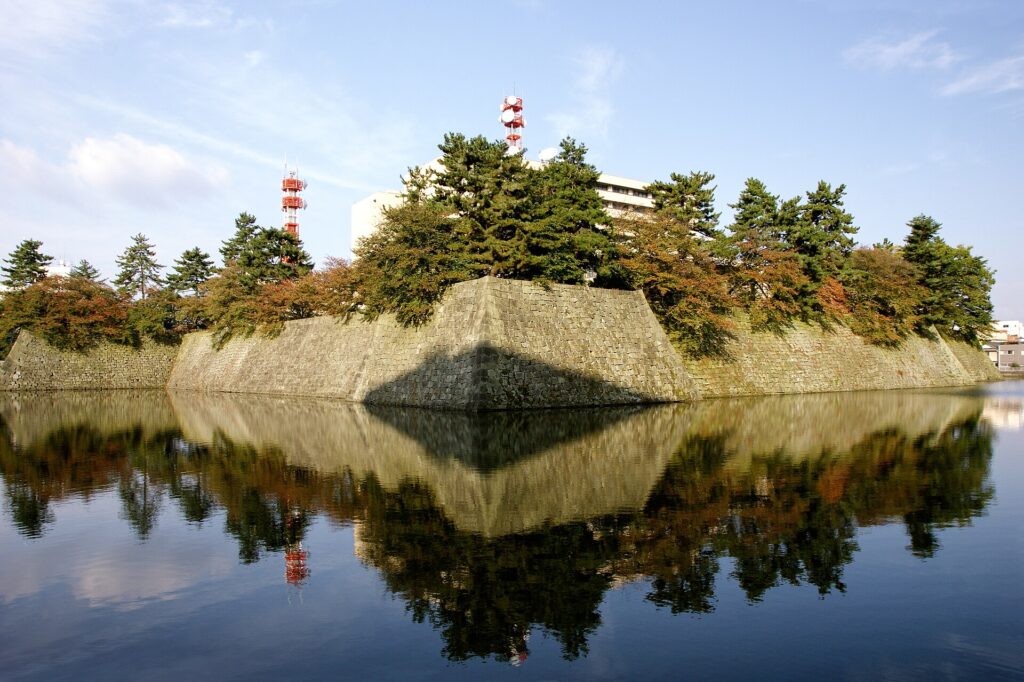
A city that was flattened three times in five years named its summer festival after the bird that rises from its own ashes.
Overview
Fukui was bombed in 1945, levelled again by the Fukui earthquake of 1948, and then flooded in 1949. The Phoenix Matsuri was started in 1954 to mark the recovery and to wish for what came next, and the name has stuck to the city itself – the main hall, the boulevard and the festival all carry it.
It is not an ancient rite and does not pretend to be. It is a modern civic festival: fireworks, a huge public folk dance, a yosakoi dance parade, a yakitori festival, and a marching band showcase. For a visitor it is the easiest way to see a mid-sized Japanese city enjoying itself without the crowds of the famous summer festivals.
When and where
In 2026 the main programme ran Friday 31 July to Sunday 2 August, with the marching event held separately on 23 August. The fireworks opened the festival on the evening of the 31st, roughly 19:30 to 20:00, over the Asuwa river between Kidabashi and Itagakibashi bridges. The folk dance filled the 1st, and the yosakoi parade took over the tram street in front of Fukui station on the 2nd.
Getting there
Fukui is on the Hokuriku Shinkansen, about three hours from Tokyo and 50 minutes from Kanazawa; from Kyoto or Osaka take the Thunderbird to Tsuruga and change. Everything happens within walking distance of Fukui station, and the Asuwa river is about 15 minutes on foot from it. Extra trains and trams run on festival days, with some regular services suspended.
What to expect
The fireworks are launched from the riverbed in the middle of the city, so you watch them from the embankment with buildings on both sides rather than from an open field – a compressed, loud, close-up version of a Japanese fireworks display. The folk dance is done in two parts, the first to three local songs and the second to J-pop arranged in folk style, and anyone can join the outer circles. The yosakoi teams perform twice along the parade route, and six finalists dance again for the top prize. Food is the third strand, with a yakitori festival running all three days – Fukui claims the highest yakitori consumption in Japan.
Admission and practicalities
Free throughout, with no reserved seating for the fireworks. Light rain does not stop the fireworks, but heavy rain or high water on the Asuwa pushes them to a reserve date. Because the festival is spread across the city centre, there is no single entrance and no bottleneck.
Tips for visitors
The embankment fills from about 18:00 on fireworks night; the stretch nearer Itagakibashi is usually less crowded than the middle. If you want to dance rather than watch, turn up to the folk dance in a yukata and join at the back – hotels near the station rent them. Note that the fixed dates shift year to year, so check the city tourism site when planning.
Access and map
| Dates | 31 July – 2 August 2026, plus 23 August |
|---|---|
| Venue | Fukui city centre and the Asuwa riverside, Fukui |
| Access | Walking distance from JR Fukui station |
| Admission | Free |
| Enquiries | Phoenix Matsuri organising committee, Fukui City, 0776-20-5325 |
Source: Fukui City official tourism site, Fuku-iro
Image: No image yet – a licensed photograph is being sourced.

.png)