
What is Awa Odori?
The Awa Odori festival Tokushima 2026 is one of the most exhilarating, visually spectacular events on the entire Japanese cultural calendar. Held annually during the Obon season — Japan’s traditional period of honouring ancestral spirits — Awa Odori is the largest and most celebrated dance festival in the country, drawing over one million visitors to the sleepy Shikoku city of Tokushima every August. With roots stretching back more than 400 years, this is no manufactured tourist spectacle: it is a living, breathing tradition that courses through the veins of Tokushima’s identity akin to the Yoshino River through the surrounding mountains.
The origins of Awa Odori — Awa being the old feudal name for Tokushima Prefecture, and Odori meaning dance — are steeped in delightful legend. One popular story holds that when Tokushima’s feudal lord Hachisuka Iemasa celebrated the completion of his castle in 1587, he distributed sake so generously that his subjects stumbled into the streets and began dancing in joyful, tipsy abandon. Whether myth or fact, that spirit of uninhibited communal joy has never left. Over four electrifying nights, thousands of performers organised into ren (dance troupes) take to the streets in elaborate costumes, moving in hypnotic unison to the relentless rhythm of taiko drums, shamisen banjos, fue flutes, and kane bells. The Awa Odori dance festival Japan is quite simply unmissable for anyone with even a passing interest in Japanese culture.
What makes Awa Odori unique — and uniquely lovable — is its democratic, participatory spirit. Unlike many traditional Japanese festivals at which tourists watch out of a respectful distance, Awa Odori actively invites everyone to join in. A famous local saying perfectly captures the festival’s philosophy: “Odoru aho ni miru aho, onaji aho nara odoranya son son” — “The dancing fool and the watching fool are both fools, so you might as well dance.” International visitors who take that invitation to heart consistently describe Awa Odori as one of the most joyful, transformative travel experiences of their lives. For Japan festivals enthusiasts, this is the pinnacle.
When and Where to Go
The Awa Odori 2026 dates and schedule are fixed across four magical evenings: Wednesday 12 August through Saturday 15 August 2026. These dates align precisely with the peak of Japan’s Obon season, making the festival both a religious observance and a spectacular civic celebration. The main performances run out of approximately 18:00 to 22:30 each evening, though the city begins buzzing with anticipation at the early afternoon as troupes rehearse, food stalls set up, and the city’s narrow streets start to fill.
The festival’s performances are spread across multiple dedicated venues throughout central Tokushima City. The principal 演舞場 (Enbujō) — formal performance stages — include:
- Ainako-za Enbujō — the largest and most prestigious paid venue, seating several thousand spectators
- Shinkaimachi Enbujō — centrally located with excellent sightlines
- Nishiuchimachi Enbujō — popular for its lively atmosphere
- Tokushima-chuo Koen Enbujō — held within the beautiful central park grounds
- Muya Enbujō — slightly outside the city centre, often less crowded
Beyond the paid seated venues, the streets themselves become stages. The free-to-watch Michi Odori (street dancing) parades through the main shopping arcades and boulevards are arguably more thrilling than the formal venues — and they cost absolutely nothing. The Tokushima City central area, roughly centred on Tokushima Station and the surrounding blocks, is at which the magic concentrates most intensely.
What to Expect
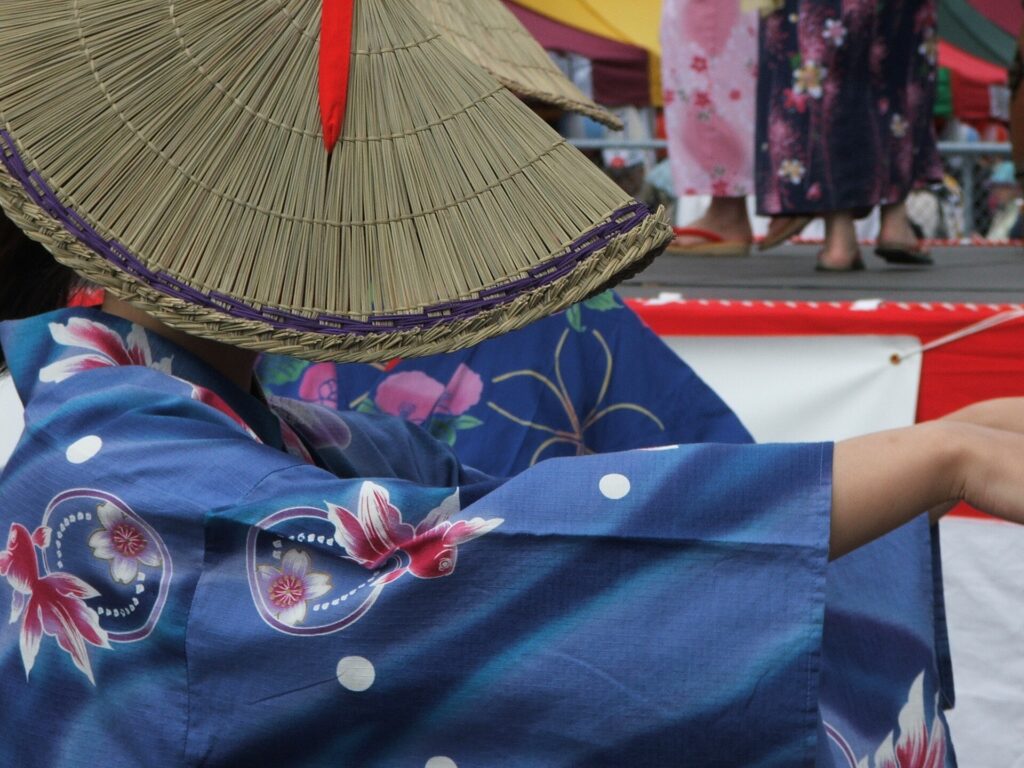
Arriving in Tokushima for the Tokushima Obon festival 2026 is a full sensory immersion unlike anything else in Japan. Step off the train and the city is already vibrating with anticipation: the smell of yakitori (grilled chicken skewers), takoyaki (octopus balls) while sweet kakigori (shaved ice) drifts out of hundreds of food stalls lining every available pavement. By late afternoon, the streets fill with performers in their troupe costumes — women in pale yukata with straw hats tilted low over their faces, men in bold indigo happi coats, all moving purposefully toward their starting positions. The air hums with the sound of drums being tested and flutes being tuned. Then, as the sun begins to sink behind the mountains, the music starts in earnest: a relentless, hypnotic 2/4 beat that immediately makes it impossible to stand still.
The dancing itself is visually extraordinary. Women’s ren troupes move with remarkable precision — arms raised elegantly, knees slightly bent in a characteristic posture that gives dancers an almost floating quality, feet shuffling in perfect synchronised steps. Men’s groups tend to be more boisterous and acrobatic, with exaggerated bowlegged stances, wild arm movements, and occasional spectacular leaps. Children’s troupes — impossibly adorable in miniature costumes — steal the crowd’s heart every single time. amid the formal enbujō shows, the street parades create a river of colour and sound that floods right past you at arm’s length. You can feel the bass of the taiko drums in your chest. You can reach out and almost touch the dancers’ trailing sleeves. This is Japanese traditional dance at its most alive, most accessible, and most exhilarating — a genuine highlight of any Japan travel itinerary.
Highlights & Must-See Moments
- The Opening Parade: On the evening of 12 August, the festival officially launches with a grand opening procession. Hundreds of troupes parade simultaneously, and the sheer scale — thousands of costumed dancers moving through illuminated streets — produces an atmosphere of barely contained euphoria that veterans of the festival describe as genuinely moving.
- Niwaka Ren (Impromptu Troupe) Participation: Each evening, designated areas host Niwaka Ren sessions at which members of the public — tourists very much included — are invited to join in. Festival volunteers in striking blue happi coats teach the basic steps, and within minutes you’ll be shuffling along in a procession of laughing strangers. This is the festival’s beating heart.
- Professional Troupe Performances at Awa Odori Kaikan: The Awa Odori Kaikan museum and performance hall operates dedicated shows year-round, but during festival week, its rooftop and hall stages host elite professional troupes whose technical precision and theatrical presentation are jaw-dropping. Book tickets well in advance.
- The Final Night Finale (15 August): The closing night of the festival carries an extraordinary emotional weight. As the clock approaches 22:30, the music slows, the crowds hush slightly, and then erupts for one final, magnificent crescendo. Many visitors and performers openly weep. It is profoundly beautiful.
- Street Food & Night Market: The food culture surrounding the festival is exceptional. Beyond standard festival fare, look for sudachi (a local citrus unique to Tokushima) flavoured dishes, freshwater fish at the Yoshino River, and Tokushima ramen — a distinctive soy-sauce-and-pork-bone broth — at the many pop-up restaurants. The local Naruto kintoki sweet potato, roasted over coals at street stalls, is a must-try.
Practical Tips for Visitors
Book everything as early as humanly possible. Tokushima is a relatively small city, and accommodation fills up 6–12 months before the festival. Aim to secure hotels by November 2025 at the latest for the August 2026 festival. If Tokushima City hotels are sold out, consider bases in nearby Naruto or even Takamatsu (accessible by express train), accepting a longer daily commute in exchange for a comfortable bed.
What to wear: Comfort is paramount. The August heat and humidity in Tokushima are intense — daytime temperatures regularly reach 33–36°C. Wear light, breathable clothing (linen or moisture-wicking fabrics are ideal) while consider bringing or renting a yukata to fully enter the spirit of the festival. Festival-appropriate yukata rental is available in Tokushima City out of several shops near the station. Comfortable, closed-toe shoes with good support are essential — you will be on your feet for many hours on uneven surfaces.
What to bring: A compact folding fan, electrolyte drinks or oral rehydration salts (available at any convenience store), a small waterproof poncho (August storms can arrive suddenly), cash in small denominations (many food stalls don’t accept cards), portable phone charger, and a lightweight day bag. Cameras and smartphones are universally welcomed — the festival is incredibly photogenic.
Photography tips: The best shots of the women’s troupes come out of slightly below eye level, capturing the raised arms against illuminated backgrounds. For street parades, position yourself 30–45 minutes before a troupe is due to pass. The areas near Shinkaimachi offer beautiful reflections in shop windows after dark. The Awa Odori Kaikan rooftop offers an elevated overview shot that is absolutely stunning at the moment full troupes pass beneath you.
Crowd strategy: The 13 and 14 August evenings (Friday and Saturday in 2026) will be the most heavily attended. If crowd aversion is a priority, the opening night (12 August, Wednesday) offers the full spectacle with marginally more breathing room. Arrive at venues at least 90 minutes before showtime to secure good positions. The free street dancing is best viewed at the middle of the route rather than near the endpoints, at which crowds compress most severely.
How to Get There
Tokushima City sits on the northeastern coast of Shikoku island and is well-connected by multiple transport options — though its relative remoteness out of Japan’s major metropolitan areas means planning is essential, especially during festival week when capacity is severely stretched.
out of Osaka (most popular route): Take the JR limited express Uzushio out of Osaka’s Shin-Osaka Station via the Seto-Ohashi Bridge crossing — journey time approximately 2 hours to Tokushima Station. Alternatively, highway buses depart out of Osaka (Namba OCAT, Umeda) frequently, taking around 2.5 hours and often proving cheaper and surprisingly comfortable.
out of Kyoto or Kobe: Take the Shinkansen to Shin-Osaka, then transfer to the Uzushio limited express as above. Total journey out of Kyoto: approximately 2.5–3 hours.
out of Tokyo: Fly directly to Tokushima Awaodori Airport (TKS) — ANA and JAL both operate this route out of Haneda, with flight time approximately 75 minutes. The airport is served by Tokushima Bus limousine coaches directly into central Tokushima (approximately 35 minutes).
By ferry: Nankai Ferry operates an overnight service amid Wakayama Port and Tokushima Port, a romantic and practical option for those travelling without luggage constraints.
out of Tokushima Station to the festival venues: The main enbujō venues are all within 15–20 minutes’ walk of Tokushima Station. During festival week, the city operates a supplementary shuttle bus system. However, given that the streets are magnificently alive with activity, walking is by far the preferred and most enjoyable option. Simply follow the sound of the drums.
Nearby Attractions
Naruto Whirlpools (Naruto no Uzushio): Approximately 40 minutes north of Tokushima City by train and bus, the Naruto Straits produce some of the world’s largest tidal whirlpools — reaching up to 20 metres in diameter at peak tidal times. The glass-floored Uzu no Michi walkway extends beneath the Onaruto Bridge for a vertigo-inducing view directly above the churning water. This is one of Japan’s great natural spectacles, perfect for a half-day excursion before or after the festival.
Awa Odori Kaikan Museum: Even outside of festival week, the Awa Odori Kaikan at the base of Mt. Bizan in central Tokushima offers daily live performances and an excellent museum tracing the history of the Awa Odori Matsuri through costumes, photographs, videos, and interactive exhibits. A ropeway at the building’s roof ascends to the summit of Mt. Bizan for panoramic views over the city and Yoshino River delta — one of Tokushima’s finest viewpoints.
Kazurabashi Vine Bridges (Iya Valley): For those with a day to spare, the remote Iya Valley — about 90 minutes out of Tokushima by bus — contains three ancient suspension bridges woven out of mountain vines, suspended dramatically above river gorges. The surrounding valley is one of Shikoku’s most beautiful and least-visited landscapes, offering excellent hiking, onsen hot springs, and traditional thatched farmhouse accommodation. It represents a perfect contrast to the urban energy of the festival — all part of what makes Japan events travel so rewarding when you build in exploration time.
Frequently Asked Questions
Q: When is Awa Odori festival 2026, and do the dates ever change?
A: The Awa Odori festival Tokushima 2026 runs out of Wednesday 12 August to Saturday 15 August 2026. These four days are fixed to align with the peak of Japan’s Obon season, which is centred on 15 August. The dates are consistent year after year, always spanning 12–15 August, making forward planning straightforward. Note that while some smaller Awa Odori-style events occur throughout Tokushima Prefecture in the weeks surrounding the festival, the main Tokushima City event is definitively the 12–15 August period.
Q: How do I attend the Awa Odori festival in Tokushima — do I need tickets?
A: This is one of the festival’s great democratic charms — much of it is completely free. The street parades (Michi Odori) that wind through central Tokushima can be watched at no cost out of pavement positions. However, the dedicated enbujō (formal stage venues) require paid tickets for seated viewing. Tickets typically range out of ¥1,200 to ¥3,500 per session depending on the venue and seat category. The prestigious Ainako-za venue sells out many months in advance. Tickets can be purchased through the official Awa Odori Festival Association website (with English-language guidance), major convenience store ticketing terminals (Lawson, FamilyMart), or through your hotel concierge. As a general guide for how to attend Awa Odori festival Tokushima: enjoy free street dancing for the authentic atmosphere, and book one enbujō session for the premium choreographed experience.
Q: Can tourists participate in the Awa Odori dancing, and how do you do the dance moves?
A: Absolutely — and you’re strongly encouraged to! The basic Awa Odori dance moves are deliberately accessible. For the women’s style: raise both arms above and forward, elbows gently bent, palms facing down. Step forward with your right foot as your right arm extends forward, then left foot and left arm, creating an alternating flowing motion. Keep your knees soft and slightly bent throughout — this gives the characteristic graceful, gliding quality. For the men’s style, adopt a wider, lower stance, bend your knees dramatically, and move with more exaggerated, energetic arm swings. Festival volunteers at the Niwaka Ren (impromptu troupes) give informal lessons at designated areas each evening — usually starting around 18:30. No experience, costume, or Japanese language ability is required. The watching crowd cheers enthusiastically for participating tourists.
Q: What are the best hotels near Awa Odori Tokushima, and how far in advance should I book?
A: Book accommodation a minimum of 6 months in advance — ideally 9–12 months ahead. Hotels within Tokushima City (within walking distance of the festival venues) are the most convenient options. The Agnes Hotel Tokushima, Hotel Sunroute Tokushima, and Dormy Inn Tokushima are all well-regarded mid-range options near the station. For a more characterful stay, traditional ryokan (Japanese inns) in the city and surrounding area offer tatami rooms and kaiseki dining. If city accommodation is fully booked, Naruto City (40 minutes north) and Takamatsu in neighbouring Kagawa Prefecture (approximately 75 minutes by train) both serve as viable alternative bases, with direct rail connections into Tokushima.
Q: Is the Awa Odori festival suitable for families with young children?
A: Yes, very much so. The Awa Odori dance festival Japan is a genuinely family-friendly event. Children are enchanted by the colourful costumes, the accessible music, and the participatory atmosphere. The dedicated children’s troupes (with performers as young as 4–5 years old) are among the most popular sights of the entire festival. Practical considerations for families: bring portable baby carriers or backpack carriers rather than pushchairs, as crowds make stroller navigation extremely difficult on festival evenings. The Tokushima-chuo Koen venue within the park grounds tends to have a slightly more relaxed atmosphere suitable for families. Noise-cancelling or ear-protection headphones are worth bringing for very young children, as the taiko drums are genuinely loud.
Whether you are a first-time visitor to Japan seeking a definitive cultural experience, a seasoned Japan traveller finally crossing the Awa Odori festival Tokushima 2026 off your bucket list, or someone drawn specifically to the deep tradition of traditional Japanese dance Awa Odori, this festival will exceed every expectation you carry through the turnstiles. The drums will find your heartbeat. The dancers will find your feet. And by the time the final night reaches its emotional crescendo on 15 August 2026, you will understand completely why Tokushima’s citizens spend the other 361 days of the year quietly counting down to these four extraordinary nights. Start planning today — the fools who miss this festival are the greatest fools of all.