
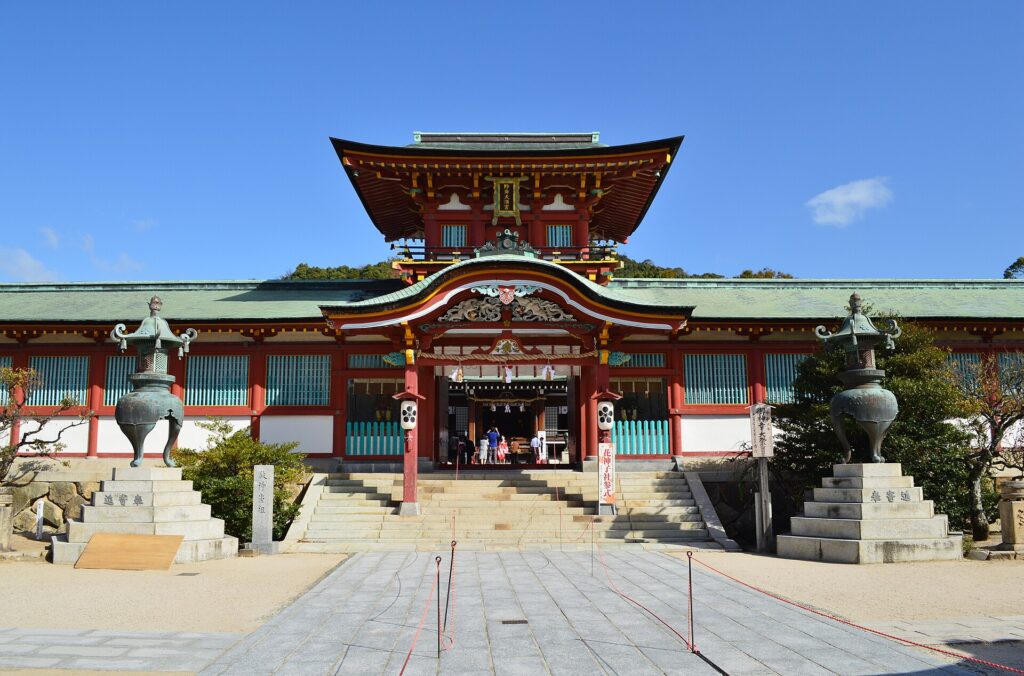
At six in the evening the shrine doors open, several thousand men in white robes surge in, and a palanquin weighing half a tonne is sent sliding down a flight of stone steps.
Overview
The Gojinko-sai of Hofu Tenmangu is a rite with an unusually specific purpose: it carries news to a god. Sugawara no Michizane, the scholar-statesman deified as Tenjin, was exiled on false charges and died in Dazaifu in 903. A century later, in 1004, an imperial envoy was sent to Hofu to perform a ceremony formally acknowledging his innocence, and the festival has repeated that message every year since. The shrine itself dates from 904 and describes itself as the first Tenmangu in Japan.
Its other name, Hadakabo Matsuri, comes from the participants. Service was once restricted to a few families; when ordinary people were later allowed to join, they had to demonstrate their purity by washing in the cold water of the Saba river and serving as they were. Around 5,000 men now take part in white robes, and the festival is known as one of the roughest in western Japan.
When and where
The festival is always held on the fourth Saturday of November, which in 2026 means Saturday 28 November. Everything centres on Hofu Tenmangu in the city of Hofu, Yamaguchi. The doors of the worship hall open at 18:00, and the palanquin returns to the shrine at around 21:00. About 150,000 people fill the town over the festival period.
Getting there
Hofu is on the JR Sanyo Line, roughly 20 minutes from Yamaguchi and an hour from Hiroshima with a change; the nearest Shinkansen stop is Shin-Yamaguchi, about 20 minutes away by local train. From JR Hofu Station the shrine is a walk of about 20 minutes straight up the main approach. By car it is around ten minutes from the Hofu-higashi or Hofu-nishi interchange on the Sanyo Expressway, but the streets close to the shrine are heavily congested in the evening.
What to expect
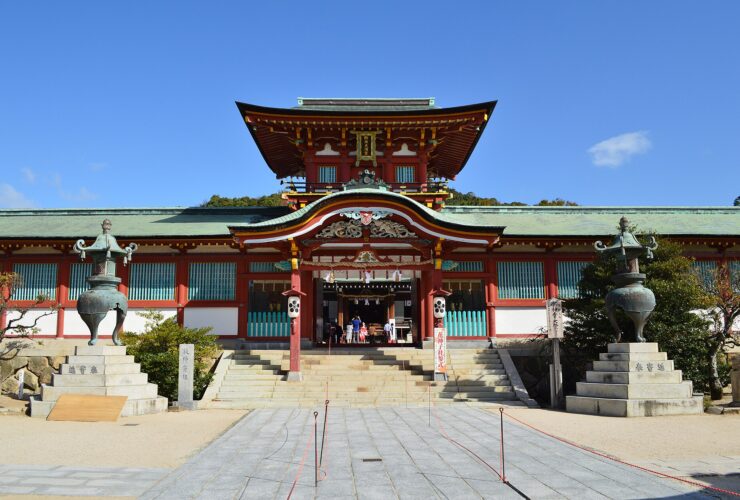
When the hall opens, hundreds of men pour in at once and the chant of kyodai wasshoi – brothers, heave – takes over the grounds. Palanquins are brought out in sequence, surrounded by a thousand or more bearers. Then the o-ajiro-koshi, the wicker palanquin holding the deity and weighing some 500 kilograms, is brought down the steps of the hall and sent down the 58-step great stone stairway below the tower gate, which is the moment everyone comes for. From there it is mounted on a cart and joins the procession to the temporary shrine at Katsuma-no-ura, about 2.5 kilometres away, at the spot associated with Michizane arrival by boat.
After the palanquin returns it is placed in the shrine corridor, and visitors may pass underneath it to receive Tenjin protection – possible from the moment it arrives back until 20:00 the following day.
Admission and practicalities
Watching is free. This is a physical festival and the crowd of bearers moves unpredictably, so stay behind the barriers and follow the stewards, particularly near the stone stairway. Note that participation is limited to men serving with an affiliated group; spectators of any description are welcome.
Tips for visitors
Get into position along the great stairway well before 18:00, since the best vantage points go early and the light fades fast at that hour in November. It will be cold standing still for hours, so dress accordingly. During the day, the Mori Clan Garden and its museum, a short bus ride from the shrine, make a good pairing – the collection includes several national treasures – and Hofu is compact enough to see both without rushing.
Access and map
| Date | 28 November 2026, from 18:00 |
|---|---|
| Venue | Hofu Tenmangu, Hofu, Yamaguchi |
| Access | About 20 minutes on foot from JR Hofu Station |
| Admission | Free |
| Note | Held on the fourth Saturday of November every year; expect heavy crowds and street closures |
Source: Yamaguchi Prefecture official travel site, Oidemase Yamaguchi
Image: Photo: Saigen Jiro / Wikimedia Commons, CC0 – the tower gate and great stone stairway of Hofu Tenmangu

.png)