
Gion Matsuri Yoiyoiyoiyama 2026: Festival Eve Guide
What is Yoiyoiyoiyama (Festival Eve)?
If you’ve ever dreamed of stepping inside a living, breathing Japanese festival — one that transforms an entire city through to a lantern-lit wonderland — then the Gion Matsuri 2026 Yoiyoiyoiyama festival eve Kyoto experience is the evening you’ve been waiting for. Held on the night of July 14, Yoiyoiyoiyama is the first of three electrifying “yoiyama” eve celebrations that build toward the grand Saki Matsuri procession on July 17. The name itself is a playful stacking of the Japanese word “yoi” (eve) repeated three times, signalling that the main event is still three nights away — yet the atmosphere on this opening evening is anything but a warm-up act.
Gion Matsuri is one of Japan’s three great festivals, with roots stretching back over 1,100 years to 869 CE, when the city of Kyoto held ritual purification ceremonies to appease the gods during a catastrophic plague. Over the centuries, what began as solemn religious rites evolved through to a month-long celebration of extraordinary craftsmanship, community pride, and spiritual devotion centred on Yasaka Shrine in the Gion district. The towering floats — known as yamaboko — that dominate the processions are rolled out and assembled weeks in advance, and by the time Yoiyoiyoiyama arrives on July 14, these magnificent structures are fully illuminated and open for viewing along the closed streets of central Kyoto. Discover more unmissable Japan festivals that rival this spectacle in scale and cultural depth.
For international tourists, Yoiyoiyoiyama holds a special appeal: it offers an intimate, street-level encounter with both the floats and the everyday life of Kyoto’s residents, many of whom throw open their machiya townhouses to display precious festival heirlooms — tapestries, lacquerware, and ceramics passed down through generations. This tradition, known as byobu matsuri (folding-screen festival), runs alongside the street celebrations and adds a layer of cultural richness that you simply won’t find at a conventional tourist attraction. Whether you’re a first-time visitor or a seasoned Japan traveller, this is an evening that rewards curiosity, patience, and an appetite for sensory adventure.
When and at which to Go
The Gion Matsuri 2026 Yoiyoiyoiyama festival eve Kyoto is scheduled for Tuesday, July 14, 2026. Festivities typically begin in the early evening — expect the atmosphere to build steadily after 18:00 and reach its peak energy amid the hours of 20:00 and 22:00, though crowds begin gathering well before sunset. The celebration concludes late in the evening, so night owls and lingering strollers will find the lantern glow at its most magical after dark.
The action unfolds across the central Shimogyo and Nakagyo wards of Kyoto, with the main float-viewing streets — historically centred along Shijo-dori, Karasuma-dori, and Shinmachi-dori — closed to vehicular traffic and given over entirely to pedestrians. The spiritual heart of the entire Gion Matsuri is Yasaka Shrine, located at the eastern end of Shijo-dori in the Gion neighbourhood. For exact street closure maps, confirmed timings, and any updates to the 2026 programme, check the official Kyoto City Tourism website or the Gion Matsuri official site closer to the event date, as annual logistics can shift. Browse more Kyoto events to plan a fuller itinerary around your visit.
What to Expect
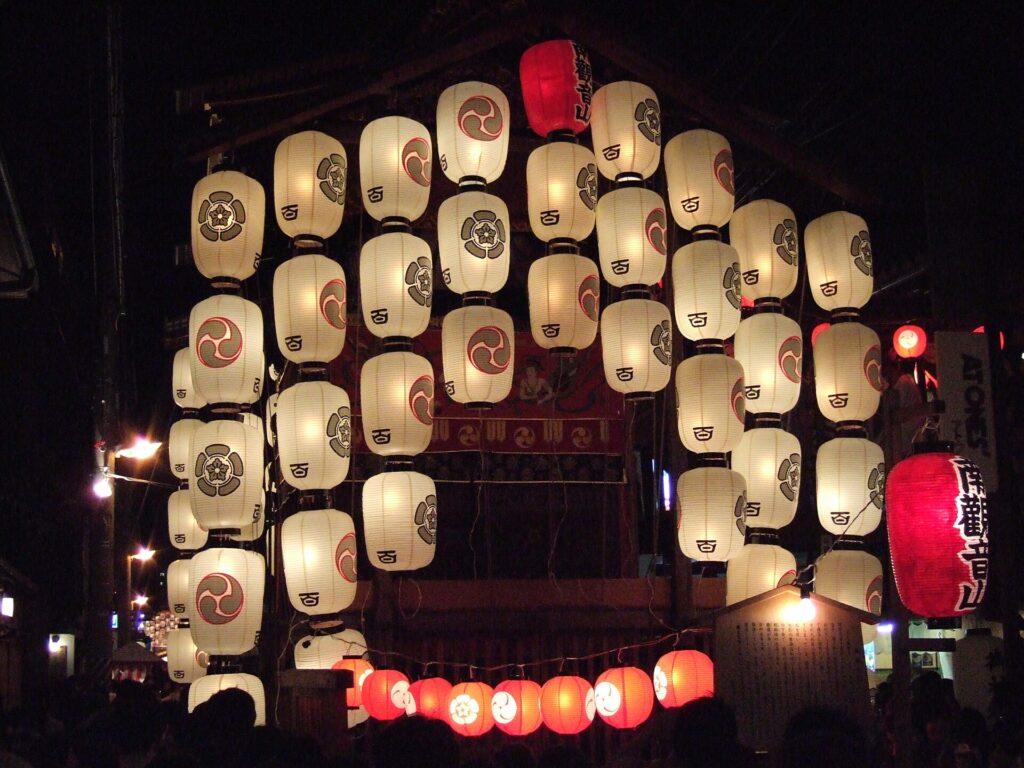
Step onto the closed streets of central Kyoto on the evening of July 14 and all five senses will be engaged simultaneously. Enormous yamaboko floats — some standing over 25 metres tall, draped in centuries-old Gobelin tapestries and glittering under hundreds of paper lanterns — line the roadways in majestic silence, attended by proud neighbourhood associations in traditional dress. The warm amber glow cast by those lanterns gives the night air a dream-inspired, almost amber-tinted quality. Street food vendors line the edges of the pedestrian zones, filling the air with the smoke and sizzle of grilled corn, takoyaki octopus balls, yakitori skewers, and shaved ice stands dispensing kakigori in vivid fruit syrups. Yukata-clad locals move through the crowds, their wooden sandals clacking against the asphalt, while the distant drone of festival music drifts overhead.
Wandering deeper through to the side streets, you’ll discover the byobu matsuri in full effect: sliding shoji screens are pulled back at traditional townhouses, revealing dimly lit interiors showcasing folding screens, ornate scrolls, and porcelain that in any other context would be behind museum glass. It’s an extraordinarily generous act of cultural sharing, and one that makes Yoiyoiyoiyama feel less similar to a ticketed tourist spectacle and more akin to being welcomed as a guest through to Kyoto’s living heritage. Expect dense crowds on the main arteries but pockets of calm on the quieter residential lanes running parallel — half the pleasure is getting a little lost.
Highlights & Must-See Moments
- Yamaboko float illuminations: The lantern-lit floats are at their most photogenic after 19:30, once the sky darkens fully. Position yourself along Shinmachi-dori or Shijo-dori for the most dramatic compositions and fewer obstructions.
- Byobu Matsuri (Folding Screen Festival): Look for open machiya townhouses along Muromachi-dori and Shinmachi-dori, you’ll find an informal but extraordinary gallery of antiques and textiles — entirely free to view and photograph (at which permitted by hosts).
- Chigo ritual child processions: On some eve nights, young boys dressed as celestial messengers (chigo) are visible near the float neighbourhoods. Their elaborate costumes and formal bearing offer a striking contrast to the festive carnival atmosphere.
- Street food crawl: The pedestrianised zones host some of Kyoto’s best summer street food. Prioritise handmade warabi mochi, Kyoto-style kyo-yasai vegetable skewers, and cold barley tea dispensed at neighbourhood stands.
- Yasaka Shrine night visit: Cap the evening with a walk to Yasaka Shrine, beautifully lit and buzzing with worshippers. The contrast amid the sacred torii gates and the festival chaos unfolding just beyond them is quietly unforgettable.
Admission & Budget
One of the great joys of Yoiyoiyoiyama is that admission to the street celebrations is entirely free. There are no tickets required and no barriers to entry for the pedestrianised zones — this is a public festival open to everyone, including international visitors. The Gion Matsuri Yoiyoiyoiyama free admission policy means your main expenditure will be on food, drinks, and any souvenirs you pick up along the way. Budget approximately ¥1,000–¥3,000 per person for a satisfying street food and drink crawl, though you can easily spend more if you browse the craft and textile stalls. Some private byobu matsuri displays may request a voluntary contribution; others are completely open. Transport costs to and within Kyoto are a separate consideration — see the section below for guidance.
Practical Tips for Visitors
- Arrive early: The best time to arrive at the Gion Matsuri 2026 Yoiyoiyoiyama festival eve is amid 17:30 and 18:30, before the post-dinner crowds flood the streets. Float viewing and byobu access are far more comfortable in the golden hour before full dark.
- Wear a yukata: Renting a yukata (casual summer kimono) for the evening is entirely appropriate for tourists and enormously fun. Many rental shops near Gion and Kyoto Station offer same-day packages including hair styling.
- Footwear matters: You’ll be walking on stone and asphalt for several hours. Comfortable sandals or flat shoes are strongly recommended — leave the heels at the hotel.
- Stay hydrated: July in Kyoto is brutally humid. Carry a refillable water bottle, a small hand towel (tenugui) while a folding fan. Heatstroke is a genuine risk; take breaks in air-conditioned convenience stores along the route.
- Crowd etiquette: Move with the flow of the crowd, avoid stopping abruptly in narrow lanes, and keep voices at a considerate level near open townhouses. Photography is generally welcome of floats; always ask before photographing residents or private interiors.
- Accessibility: The pedestrianised streets are flat and paved, making navigation manageable for wheelchair users, though peak-hour crowd density can be challenging. Visit on the earlier side of the evening for more comfortable access.
- Cash is king: Many street vendors operate cash-only. Withdraw yen in advance at a 7-Eleven or Japan Post ATM.
How to Get There
Kyoto is supremely well connected and makes an ideal destination for a Gion Matsuri day trip out of Osaka or Tokyo in 2026. Departing Tokyo, the Tokaido Shinkansen (bullet train) reaches Kyoto Station in approximately 2 hours 15 minutes on the Nozomi service. Departing Osaka, Kyoto is just 15 minutes via the Shinkansen or approximately 28 minutes via the JR Special Rapid Service — an easy evening excursion. Departing Nagoya, journey time is roughly 35–40 minutes by Shinkansen.
Once inside Kyoto, the festival zone is reachable via the Hankyu Kyoto Line (alighting at Karasuma or Kyoto-Kawaramachi stations) or the Kyoto Municipal Subway Karasuma Line (alighting at Shijo Station). On festival evenings, these stations will be crowded — plan extra transit time. Important: private vehicles and taxis will be unable to access the closed festival streets; public transport is strongly recommended. For precise exit numbers, real-time street closure maps, and any shuttle bus services operating in 2026, check the official Kyoto City Tourism Association website closer to the date. Explore further Japan travel guidance to plan your wider Kansai itinerary.
Frequently Asked Questions
Q: What is the best time to arrive at Yoiyoiyoiyama to avoid the biggest crowds?
A: Aim to arrive in the festival zone by 17:30–18:00. The crowds build steadily after 19:00 and become very dense amid 20:00 and 21:30. If you’re visiting for the first time, an earlier arrival lets you view the floats and byobu displays with breathing room, enjoy street food without long queues, and still stay on for the magical lantern-lit peak hours later in the evening.
Q: Can foreigners attend Gion Matsuri Yoiyoiyoiyama, and is it easy to navigate without Japanese language skills?
A: Absolutely — international visitors are warmly welcomed at Yoiyoiyoiyama, and the open-air, pedestrian street format requires no reservations, no Japanese language skills, and no tickets. English-language signage has improved significantly in recent years along the main festival streets, and many float neighbourhood associations produce bilingual information sheets. Google Maps functions reliably in Kyoto and will help you orient yourself amid the street closures.
Q: What should I wear to Gion Matsuri festival eve in July?
A: Light, breathable clothing is essential — July in Kyoto is hot and intensely humid, with evening temperatures often remaining above 28°C. A yukata (summer kimono) is a delightful and culturally appropriate choice, available for rent near the festival area. Otherwise, opt for loose linen or cotton clothing, flat comfortable shoes suitable for extended walking, and carry a small towel and folding fan. A compact umbrella is also useful, as summer evening showers are not uncommon in Kyoto.
There are few evenings in the Japanese travel calendar that match the sheer, joyful intensity of the Gion Matsuri 2026 Yoiyoiyoiyama festival eve in Kyoto. This is a celebration that has endured for over a millennium precisely because it continues to feel vital, communal, and genuinely moving — not a performance staged for visitors, but a living tradition that tourists are privileged to witness. Mark July 14, 2026 in your travel diary, pack your lightest summer clothes, and prepare to fall completely in love with Kyoto after dark. It’s an evening you will be describing to friends for years to come.